Digital platforms and ecosystems
A new dawn for SMEs
.png?width=770&height=385&name=Blog%20Titelbild%20(5).png)
Amazon, Apple, Google: we all use digital platforms and ecosystems every day - and the big players have shown how entire markets can be revolutionized. One tenth of the world's gross domestic product is already generated by the platform economy. Now is the ideal time for SMEs to take advantage of these opportunities and develop their own business models.
The platform economy has shifted the balance of power in many markets like no other digital business model. Just imagine: The enterprise values of Amazon and Alphabet alone exceed those of the 30 DAX companies combined. In the platform economy, digital platforms act as intermediaries between groups of players such as customers, providers and users in order to facilitate the exchange of products, services or information. In doing so, they cleverly use scaling effects to reduce costs through high user numbers and network effects that generate added value through growing numbers of participants. In short, each new user makes the platform more attractive and thus strengthens its competitive position and market position.
Potential of the platform economy for SMEs
Many fascinating virtual marketplaces with hybrid products and smart services are currently emerging in the platform business. With the right approach and the optimal strategy, SMEs can also benefit from digital business models. The current study "Digital platforms as an opportunity for SMEs" by Mittelstand Digital gets to the heart of the matter:
"Digital platforms offer SMEs enormous opportunities to develop strategically - changing entire industries in the process."
Digital platforms can provide companies with strategic advantages, higher turnover and cost savings. According to surveys, over 50% of SMEs see great to very great opportunities, particularly through new opportunities for cooperation (88%), improved sales (86%) and the development of new business models (81%). Process and efficiency improvements, such as optimized sales, order and payment processing and more targeted advertising are also relevant.
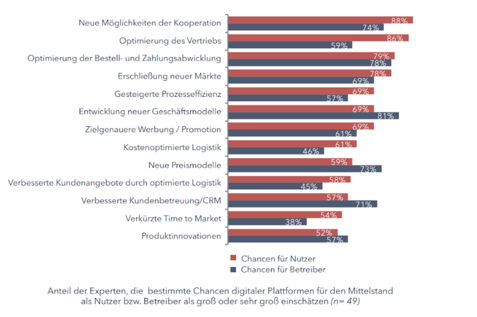
Fig. 1: Digital platforms - SMEs see great to very great opportunities (source: Mittelstand Digital)
For SMEs, it is not a question of copying the solutions of large companies, but of using the mechanisms of successful platforms intelligently for themselves. Companies have a choice: either they develop and operate their own platform-based business model or they use existing platforms to offer their products and services. Both approaches offer attractive opportunities.
Opportunities for platform operators:
- Development or expansion of business models
- Acquiring new customer groups through network effects
- Securing the future through a digitalized product portfolio
- Gaining valuable data on consumer behavior
- Rapid scalability of the offering
Opportunities for platform users:
- Opening up new markets through new customer groups and cooperation partners
- Efficiency gains through digitalized ordering and billing processes
- Strategic use of the platform economy enables SMEs to remain competitive and tap into new growth opportunities
B2B platforms are particularly interesting
Depending on its purpose, a platform can be structured as an online marketplace, brokerage platform, social network or even a search engine. As studies show, digital platforms in the B2B sector in particular offer enormous growth potential, as many gaps in the market have not yet been exploited. According to the Entrepreneurs Club Cologne (ECC), B2B sales on digital marketplaces have grown by an average of 52% in the last three years, compared to "only" 19% for online stores. The market share of B2B marketplaces has therefore almost doubled and currently stands at 27%.
One example of success in this country is Momox GmbH, Germany's largest Amazon retailer for used books: sales climbed from EUR 147.9 million to EUR 250 million in 2024.

Fig. 2: Internet sales with B2B platforms in Germany (source: Grant Thornton)
How to make the platform work - 8 key topics for SMEs
When setting up a platform today, what counts above all is outstanding customer benefit - and added value for all parties involved. The following topics are relevant for SMEs:
Focus on customer benefits
In the platform business, the focus is no longer on products or services, but on customer benefits: Today, platforms actively solve customer problems and continuously improve the customer experience. Involving customers in the development process reduces the risk of undesirable developments and enables rapid adjustments, which stimulates both demand and supply. A growing supply in turn leads to network effects and creates added value for everyone involved.
In the music business, Spotify demonstrates this shift towards customer centricity by offering a wide range of music, personalized playlists and cross-device music listening for a holistic customer experience.
Strategic partners and alliances
Clever collaborations are opening up completely new business opportunities today. Coopetition (a combination of cooperation and competition), for example, enables SMEs to develop innovative solutions together with competitors through smart partnerships. Companies often transform themselves from pure providers to infrastructure operators and orchestrators in order to deliver solutions as effectively as possible.
Car manufacturers, for example, have created a joint platform with IONITY to establish a comprehensive charging station network for electric vehicles in Europe.
Own infrastructure as a competitive advantage
Having your own physical infrastructure has many advantages in the platform business: You retain full control over your own services and ensure that they are provided efficiently and with consistently high service quality; maximum customer benefit guaranteed. Opening up to third parties and external partners also creates excellent conditions for additional, new sources of income - a key factor for additional growth.
Amazon and the Otto Group, for example, are investing in their own delivery services to improve the customer experience in e-commerce.
Attracting more users and interactions
Platforms become more valuable the more interaction and active users they have. To increase the interaction rate, SMEs can either (a) expand their offering or (b) network their products with others. The goal: ecosystem approaches with multiple revenue structures.
For example, Philips and BSH products used to be sold individually - today they are part of a new ecosystem: Philips with Hue and BSH with Home Connect, which offer greater convenience in the smart home through networking.
Meeting changing customer needs
Digitalization has significantly changed the exchange of goods and, above all, customer behaviour. Customers obtain comprehensive digital information before, during and after their purchase and also expect ever more sustainable, user-friendly and faster digital solutions. These changing expectations must be met with tailor-made offers.
Take Otis, an example from the elevator industry: the search volume increased by up to 200% in some European countries between 2020 and 2022
Design & architecture of the platform
Platform design starts with defining the central interaction that delivers the main benefit for your customers. This interaction determines the participants (suppliers & buyers), the transactions (goods or services) and the search filter for a personalized user experience. There are three main strategies to increase customer value:
- Pull: Attraction through an outstanding customer experience. High value and smooth processes attract customers and reduce marketing costs.
- Facilitate: Lowering barriers to entry. Simple registration processes and payment methods as well as minimization of risks and effort for users.
- Matchmaking: Effective connection of supply and demand. Fast, precise linking (customers, providers) based on data analysis along the customer journey.
Prominent examples are airbnb (i.e. simple accommodation search with intuitive filter function) and Google (i.e. effective search with high hit accuracy & minimalist design).
Cultural change
The cultural change in platform companies is reflected in hypothesis-based approaches, flat hierarchies and new ways of working. In particular, the battle for digital specialists is resulting in more flexible working models and better benefits for employees. The shift towards customer centricity and digital technologies is not only influencing value creation, but also the behavior of the workforce, especially experienced digital professionals who are introducing new ways of working to better serve their customers.
Companies such as Hello.Beta Hub GmbH promote exchange via networks to share successful cultural change methods and overcome obstacles.
Revenue models and monetization
Digital platforms offer SMEs a wide range of monetization opportunities, even without their own products or services. Scalability and network effects increase their attractiveness and market position. Possible revenue models are, for example
- Transaction fees: Percentage of each transaction processed
- Subscriptions: Payments for access to exclusive content or premium services
- Advertising revenue: Use of the community for targeted advertising
- Additional services: Advanced features for a fee
Next level: networks and ecosystems
The Deloitte study Digital Strategies in SMEs examined the extent to which the trend towards the platform economy and digital ecosystems has already arrived in SMEs. Here are the key findings:
- 83 percent of SMEs are not familiar with the term "ecosystem" in a corporate context
- However, 53% attribute very high importance to corporate networks
- Top advantage of ecosystems: improved customer relationships, more targeted customer approaches & more precise alignment with customer wishes (74%)
- Further advantages: Sustainable optimization of business processes (73%), development of new business models (58%) and increased efficiency in product development (52%)
Lutz Meyer, Head of SME Program at Deloitte, comments:
"SMEs are in a transformation phase. In principle, they are aware of the importance of ecosystems, or at least have an inkling of it. The results also show an intensive engagement with the topic. Some companies are already participating in several ecosystems in parallel or are even building their own."
Central roles of companies in ecosystems
- Integrator: Controls the entire value chain and carries out all activities itself. Typical for traditional SMEs.
- Layer player: Specializes in a specific service in several value chains (e.g. logistics)
- Market maker: Creates marketplaces for new value chain combinations (e.g. Uber)
- Orchestrator: Concentrates on core competencies and delegates other activities in the ecosystem (e.g. adidas)
The Deloitte study shows that many SMEs (58%) still rely heavily on a high level of vertical integration and the majority act as integrators, meaning they have full control over their value chain. Successful companies are now increasingly expanding their business model to include complex solutions instead of just offering linear products. 55% are already actively involved in ecosystems and the particularly successful companies among them are aware of their importance (78%).
"SME ecosystems are still comparatively small today - the number of players remains in single figures. What SMEs should tackle now is examining the strategic consequences and technical feasibility of their own platform solution, promoting digitalization within the company and linking the emerging ecosystem with a new, appropriate management strategy, structure and culture."
Lutz Meyer, Head of SME Program at Deloitte (Source: Deloitte)
Technology, process and strategy expertise essential
Platform use requires a deep understanding of technical, procedural and strategic aspects. According to a survey by Mittelstand Digital, 58% of SMEs see a shortage of skilled workers and a lack of expertise as the main barriers to introducing digital platforms. One thing is clear: SMEs must not only adapt individual processes, but also their business models in order to be successful. They can then secure competitive advantages and transform entire value chains into networks. Like the big players.
Digital platforms have enormous potential in all sectors. They already generate a tenth of global GDP. Despite all their innovative power, over 80 percent of platforms fail!
Our guide shows you the 5 most important steps on the way to a successful platform economy - from the right setup to monetization and scaling.