HubSpot Customer Agent
How AI Automates Email Support in the Help Desk and Reduces the Workload on Teams
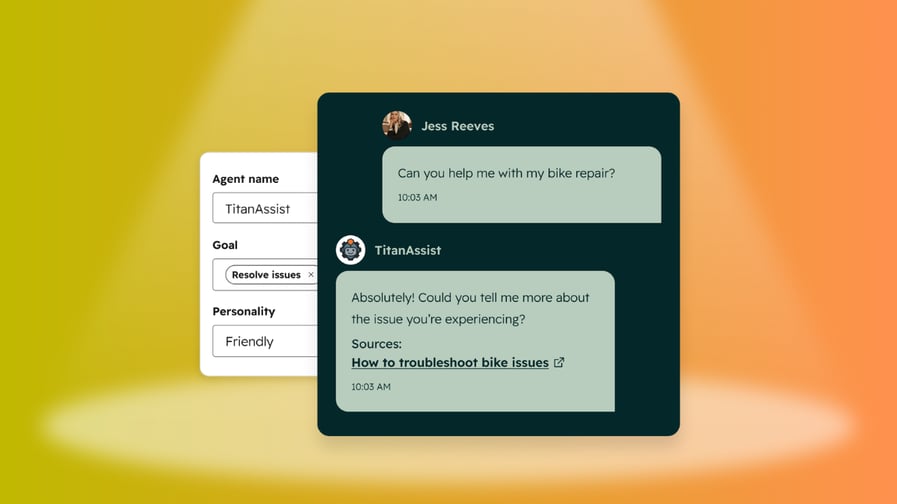
Support is one of the most important points of contact between companies and customers. It is precisely here that it is decided whether an experience remains positive or turns into frustration.
And at the same time, this area is often one of the most stressed today.
Email remains the central channel in support - not because it is efficient, but because it is used everywhere. The problem is well known: increasing ticket volumes, recurring inquiries and little time for the really complex cases.
The result is a system that is constantly responding but rarely really scales.
What the Customer Agent changes
Customer Agent automates one of the most critical parts of support - but not as rigid automation, but as a controllable AI agent in the help desk.
Teams decide for themselves how to use it: They can automate a certain proportion of requests, limit its use to defined times or have responses checked first before they are sent.
This is not an "all-or-nothing" approach, but a controlled introduction to AI-supported support.
The difference lies in the way the agent works: It doesn't just respond to individual messages, but uses context.
Support with context instead of individual requests
Many support solutions only see the moment of the request. HubSpot's Customer Agent works differently.
It combines several levels of context:
- existing knowledge from the help desk, website and internal documents
- the complete customer history and previous interactions
- and the content of the current conversation, including attachments
This results in answers that are not generic, but are tailored to the specific customer case.
This fundamentally changes the quality of responses: from reactive to context-based.
From a flood of tickets to real relief
In practice, this leads to a noticeable change in day-to-day support.
Standard inquiries are disappearing from day-to-day operations, while teams are gaining more capacity for complex and sensitive cases.
The crucial point here is not just speed, but structure: queries are resolved more consistently, handovers between AI and humans become cleaner and the entire support process becomes more predictable.
Customer Agent does not replace teams, but shifts their work to areas with higher value.
A pricing model focused on results - and an easy way to get started
A key part of the Customer Agent update is not only the functionality itself, but also the way it is used and billed.
Instead of charging for classic usage or pure tool interaction, HubSpot relies on a results-based model: credits are only due when a support request has actually been resolved. In other words, it is not the activity that is paid for, but the result.
This significantly reduces the risk for support teams - and at the same time makes it clear how much HubSpot values this model: The Customer Agent should not just be tested, but should generate impact in real operations.
To get started, there is currently a 28-day free trial period during which teams can try out the Customer Agent without credit billing. This is particularly relevant for teams that are using AI in support for the first time in a structured way and want to validate their specific use case directly in day-to-day operations.
The difference to traditional support tools
Many support systems are either rule-based or work purely generically on the basis of individual text entries. They answer queries, but rarely understand the entire context behind them.
Customer Agent takes a different approach.
Because it is embedded within HubSpot, it accesses the entire customer relationship - not just the current request, but also previous tickets, interactions and existing customer knowledge.
In addition, the team remains in control at all times: tonality, behavior and degree of automation can be specifically controlled and gradually adapted.
This makes the introduction of AI-supported support controllable rather than experimental.
Typical application scenarios in everyday life
Many teams deliberately start cautiously and initially only use Customer Agent outside of business hours. This means that recurring queries are processed automatically, while more complex cases end up in the help desk the next day in a structured manner.
Other teams use a human-in-the-loop model. The agent creates suggested answers that are checked and sent by employees. This ensures speed without losing control over quality.
In both cases, a similar pattern emerges: teams start with relief and gradually develop trust in automation.
Conclusion: Support is not replaced, but redistributed
Customer Agent does not change support as a function, but rather the way in which work is organized within it.
Routine requests are automated, while teams can concentrate on complex and value-adding cases. This not only makes support more efficient, but also more stable and consistent.
For many companies, this is precisely the decisive step: away from reactive ticket processing and towards a scalable support system that grows with the company.