Reaching the right companies at the right time
How modern prospecting works
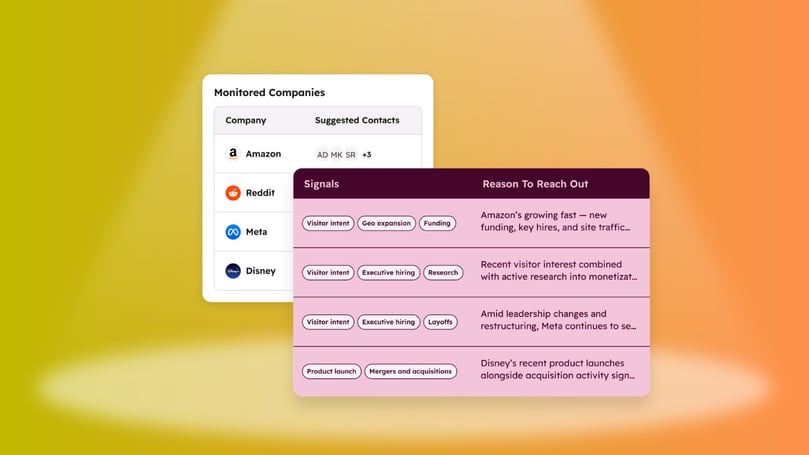
Prospecting is one of the most important, but also one of the most time-consuming tasks in sales.
Before an initial conversation can even take place, suitable accounts must be identified, relevant contacts found and suitable outreach strategies developed. In practice, this often means that sales teams spend a lot of time researching data, maintaining lists and switching between different tools.
The actual goal - getting in touch with the right people at the right time - often takes a back seat.
The classic prospecting process is fragmented
In many teams, prospecting is not a coherent process, but a sequence of individual steps.
Accounts are researched in one tool, contact details are searched for in another and outreach measures are planned and implemented separately. This separation leads to valuable time being lost and important signals from the market not being used consistently.
In addition, many of these activities are controlled manually. Reps have to decide for themselves which accounts are relevant, where to look for contacts and how to formulate their approach.
The result is a process that relies heavily on manual work and is only scalable to a limited extent.
Prospecting Agent as an end-to-end approach
HubSpot's Prospecting Agent takes a different approach. Instead of isolating individual steps, the entire prospecting process is brought together in one system. From the recognition of relevant accounts to the identification of contacts and the approach, everything is supported within a standardized environment.
The agent takes on three central tasks that map the entire process.
Firstly, it identifies accounts that have a high purchase probability based on signals. These include, for example, changes in the company, new job advertisements or investment rounds. These signals help to identify the right time to approach an account.
The agent also identifies the relevant contacts within these companies. If complete data is not yet available in the CRM, additional contacts can be added via connected data providers. This creates a complete picture of the buying group.
In the final step, the agent supports the approach itself. Based on the available information, personalized outreach suggestions are created that are oriented towards the respective signals and the existing context. Reps can check these suggestions, adapt them and use them directly.
From research to real sales work
The biggest difference lies in the way time is used in sales.
Instead of spending hours on research, sales teams can focus on the actual interaction with potential customers. The relevant information is already prepared and directly available.
This means that reps no longer have to start from scratch, but can approach customers with a clear context.
This difference has a direct impact on the quality of conversations. Instead of sending generic messages, communication is based on concrete signals and actual interest.
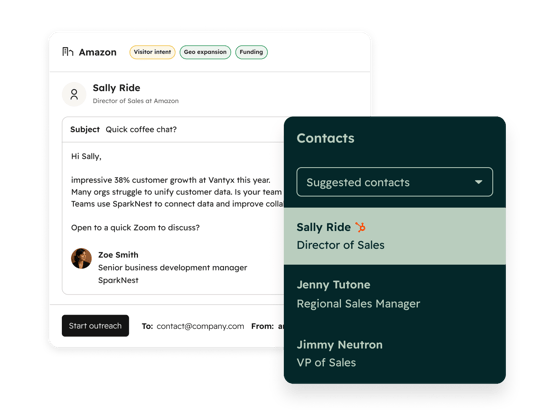
More pipeline through better prioritization
A key advantage of the Prospecting Agent lies in the prioritization of accounts.
Not all potential customers are relevant at the same time. The agent helps to identify precisely those accounts that are currently showing buying intentions.
This allows sales teams to focus their energy on the opportunities that are most likely to lead to a deal.
At the same time, it ensures that no important signals are overlooked. Changes in the market or in a potential customer's company are recognized and presented in the right context.
This leads to a much more efficient use of available resources and a higher quality pipeline.
The difference lies in the context
The key factor that sets the Prospecting Agent apart from other solutions is access to full context.
Many tools can provide data, but they do not understand how to evaluate this data in the respective sales context. For example, they may show that a company has received financing, but they cannot classify whether this signal is actually relevant for their own sales.
Prospecting Agent, on the other hand, uses the entire context from HubSpot.
This includes
- Interactions with existing contacts
- Behavior on the website
- Previous conversations and activities
- as well as the company's specific positioning and offering
This combination makes it possible to recognize not only what is happening, but also why it is relevant.
On this basis, outreach messages are created that feel natural and actually address the situation of the company in question.
Prospecting becomes a continuous process
Another important difference lies in continuity.
Instead of creating one-off lists, Prospecting Agent works permanently in the background. It continuously monitors the market, recognizes new signals and updates the prioritization of accounts accordingly.
For sales teams, this means that they receive an updated list of relevant accounts every day, including suitable contacts and a prepared approach.
Prospecting is thus transformed from a one-off task into an ongoing process that is based on current developments.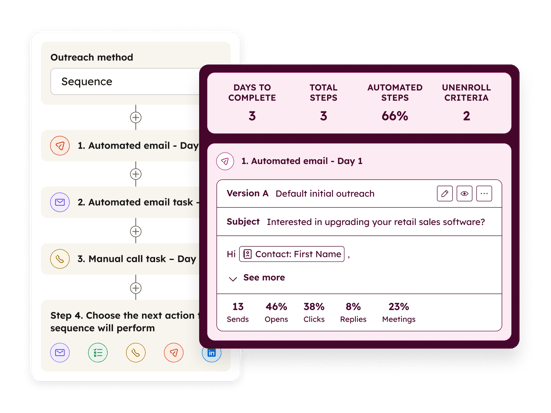
A pricing model based on the result
With the Prospecting Agent, HubSpot is also taking a consistently new approach to its pricing model. The focus is no longer on pure access to a function, but on the specific benefit that arises from it.
Instead of paying for the basic availability of a tool, companies pay for a solution that actually delivers results - in other words, when the Prospecting Agent actively identifies relevant accounts and contacts and thus creates real added value for the sales process.
This model makes it clear how strongly HubSpot believes in the quality of its approach: the focus is not on usage, but on impact. This fits in perfectly with the basic idea of the Prospecting Agent - less time for manual research, more time for real sales work with the right contacts.
The Prospecting Agent can currently be tested free of charge for 28 days so that teams can try out the approach risk-free in their own day-to-day sales work.
Conclusion: Prospecting that is geared towards the real market
Prospecting Agent not only changes how sales teams work, but also what they spend their time on.
Instead of working through different tools and data sources, an integrated process is created that brings together all the relevant steps.
The result is a prospecting approach that is closer to what is actually happening in the market and helps sales teams connect with the right people faster and in a more targeted way.
And therein lies the difference: not doing more, but doing the right thing at the right time.
The next level in AI-powered prospecting
If you want to understand more deeply what modern, AI-supported prospecting looks like in practice, we have developed a playbook that starts right here.
In the "AI Prospecting Playbook for Sales Leaders", we show you step by step how to identify ready-to-buy accounts early on, set up complete buying committees and fill your pipeline much more efficiently - with minimal manual effort.
Among other things, you will learn
- how to automatically identify and correctly prioritize buying signals
- how AI helps you to build complete buying groups in CRM
- how to design outreach with real context instead of generic messages
- and how your team stays in control through a human-in-the-loop model while AI reduces effort
If you want to put this into practice, you can download the playbook for free here.