HubSpot CRM in Action
When Is It Worth Switching CMS?

Are you already using HubSpot for marketing, sales, or customer management, but your website is still running on WordPress, TYPO3, or another CMS? Many companies rely on exactly this combination. But with growing demands for personalization, automation, and AI, it’s worth taking a closer look at your existing system landscape.
After all, a modern website can do much more than just provide information. It can leverage customer data, support marketing and sales processes, and enable personalized digital experiences. So the question is: How much potential goes untapped when your website and CRM run on separate platforms?
We’ll show you when it makes sense to consider switching to HubSpot Content Hub, what opportunities an integrated platform opens up, and what you should keep in mind when making your decision.
5 Signs That Switching CMS Might Be Worth It
In general, many external CMS platforms can be connected to HubSpot via forms, tracking, APIs, or additional integrations. But the more demanding your requirements become, the more important it is for your website, data, and processes to work together seamlessly.
These five situations may indicate that it’s time to rethink your current CMS strategy.
1. Your website doesn’t sufficiently support marketing and sales
Does your website generate inquiries, but the subsequent journey of prospects is only partially traceable? Or is relevant information from website interactions not fully available in the CRM? A tighter integration of the systems can help you better understand prospects, qualify leads more effectively, and align marketing and sales activities.
2. New features are becoming increasingly time-consuming
Whether it’s product finders, dynamic content, personalized customer areas, or additional interfaces: technical complexity increases with every new requirement. If enhancements regularly require custom solutions or if multiple systems must be laboriously integrated, it’s worth asking whether an integrated platform would be more efficient in the long run.
3. Existing CRM data remains unused on your website
Your CRM already contains valuable information about your customers, their interests, and past interactions. Yet on the website, everyone is shown the exact same content. This data could be used, for example, to provide existing customers with different information than new prospects or to tailor content specifically to certain target groups.
4. Your marketing team is too dependent on others for changes
Does every new landing page, campaign, or adjustment require involving IT or an external agency first? A modular CMS can give marketing teams significantly more autonomy. At the same time, complex technical functions and integrations remain under professional management.
5. A relaunch or strategic overhaul is on the horizon
If your website is due for a major overhaul anyway, this is a good time to also reevaluate the technical platform. After all, a relaunch isn’t just about a new design. Data integration, content processes, personalization, automation, and future requirements should also be taken into account from the very beginning.
What does a website hosted directly in HubSpot offer?
With HubSpot Content Hub, you can manage your website within the same platform you already use for your customer relationships. The advantage lies not only in the CMS, but above all in the synergy between the website, CRM data, and marketing processes.
Personalized website content: Imagine an existing customer visiting your website and immediately seeing information about relevant services or upgrade options. A new prospect, on the other hand, first receives basic information about your services. HubSpot enables you to deliver content in a more targeted manner based on defined criteria and existing CRM data—depending on the features and licenses you use.
Seamless marketing and sales processes: A prospect visits a product page, downloads additional information, and then registers for a webinar. These interactions can be consolidated in HubSpot and used for further communication. This makes it easier to track customer journeys and coordinate marketing and sales activities more effectively.
More Efficient Content and Campaign Management: Landing pages, website content, forms, and marketing campaigns can be created, managed, and analyzed in a single environment. Custom-developed, reusable content modules simplify maintenance and enable marketing teams to make many adjustments on their own.
How does this change day-to-day marketing operations?
The benefits of an integrated platform are particularly evident in day-to-day workflows. A comparison of typical work scenarios highlights where processes can be simplified:
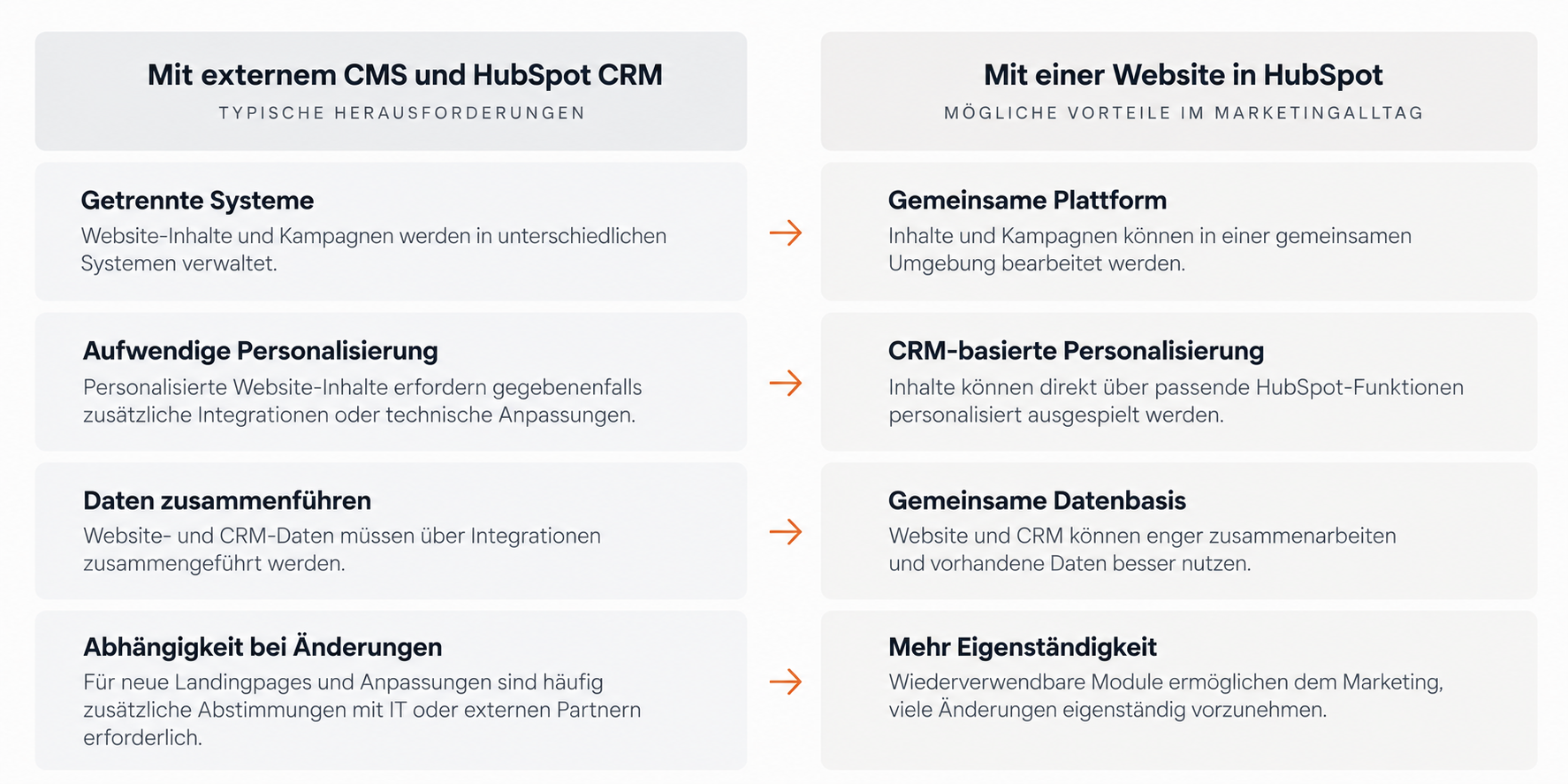
Of course, these differences also depend on how well the existing website is already integrated with HubSpot. For many marketing teams, however, a unified platform can mean less coordination between different systems is needed, leaving more time for actual marketing work.
What additional opportunities does AI open up?
AI is changing not only how people search for information, but also how companies create, personalize, and refine digital content.
With its AI features, HubSpot offers ways to create website content, adapt existing content for different formats, and support marketing teams in their day-to-day work.
It becomes particularly exciting when AI features, CRM data, and website content work together within a single platform. This is because existing information and processes can then be leveraged more effectively for content development and personalized communication.
Here’s an example: Your company wants to launch a campaign targeting different industries. The CRM already contains information about the respective target audiences and their interests. Based on this, appropriate content can be designed, and various text variations can be developed with AI support. Relevant content can then be displayed on the website using suitable personalization features.
AI supports content production, CRM data provides the context, and the CMS delivers the content. The specific features available depend on the HubSpot products and licenses in use.
So what matters isn’t which CMS offers the most AI features, but how well AI, customer data, and website processes can be integrated with one another.
What does switching CMSs mean for your existing website?
Switching CMS doesn’t necessarily mean your entire website has to be rebuilt from scratch. Depending on the initial situation, existing content, designs, and structures can be carried over or further developed as needed.
Careful planning is essential, however. Before the migration, you should determine which pages and features will remain, which integrations are needed, and whether the existing content structure can be meaningfully carried over. Existing URLs, redirects, and SEO rankings must also be taken into account to ensure the website remains easily discoverable after the switch.
A structured migration is particularly crucial for large-scale websites with multiple languages, custom features, or complex system integrations. Technical implementation, content migration, and quality assurance must work together seamlessly.
A well-planned CMS migration also offers the opportunity to simplify established structures, optimize existing content, and better align the website with future requirements.
Case Study: How COPA-DATA Integrates Its Website, CRM, and Marketing
Our project with COPA-DATA, an internationally active software company specializing in industrial and energy automation, demonstrates how an integrated platform can work in practice.
The initial situation was characterized by disparate systems for the website, campaigns, reporting, and CRM. In some cases, information had to be maintained multiple times, and coordinating international marketing activities was time-consuming.
Together, we further developed the digital platform and, among other things, migrated the global corporate website—with approximately 1,000 multilingual website and blog pages—to HubSpot Content Hub.
This involved far more than a traditional CMS migration. By integrating the website, CRM data, and marketing processes, we created a central platform for international content management, personalized website content, and more efficient lead qualification. AI-powered translation features also support international content management.
The project demonstrates how an integrated platform can lay the foundation for scalable, data-driven marketing processes.
Learn more about the project with COPA-DATA
When does switching CMS make sense—and when doesn’t it?
Switching to HubSpot Content Hub can be particularly beneficial if you want to integrate your website more closely with marketing and sales processes, use CRM data for personalized content, or develop new digital features.
However, the key factor is the specific added value the migration creates for your company. It’s worth considering not only the one-time project costs and ongoing licenses but also potential savings and improvements: How much time could your marketing team save through more efficient processes? Can technical dependencies and maintenance efforts be reduced? Can campaigns be implemented more quickly, and can existing CRM data be better leveraged for lead generation?
If your existing CMS already integrates well with HubSpot and meets your current and future requirements, targeted enhancements may make more sense than a complete migration.
This assessment isn’t always easy, especially with more complex system landscapes. That’s why we help companies analyze their existing website and CRM processes, identify opportunities for improvement, and find the solution that makes the most sense both economically and technically.
To learn more about the possibilities HubSpot offers for sophisticated, CRM-integrated websites and how we at konzepthaus support companies in implementing them, visit our service page for HubSpot CMS and website development.
Conclusion: What matters most is what your website is supposed to achieve
If you’re already using HubSpot as a CRM, you have a solid foundation for more closely integrating your website, customer data, and digital processes. An integrated platform can help streamline marketing activities, create personalized customer experiences, and unlock new opportunities through AI and automation.
Perhaps that’s why now is the perfect time to take a closer look at your existing website strategy: Are you already taking full advantage of your HubSpot platform, or is there still untapped potential in integrating your CRM with your website?
Curious to discover what else is possible in the digital world?
What makes a modern website stand out today? What opportunities do AI, CRM, and automation offer? And which HubSpot updates should you know about?
With our konzepthaus Tour Guide newsletter, we regularly take you on a journey of discovery through the digital world. Look forward to practical tips, inspiring real-world examples, and fresh ideas you can put to use in your business. We'll also keep you up to date on interesting webinars and our upcoming events.
Every one to two months, you'll receive fresh insights straight to your inbox. Practical, informative, and focused on topics that really help you move forward.