Partner Portal
How to Simplify Offers, Communication, and Processes

Collaboration with business partners often involves much more than just the occasional exchange of information. Joint marketing campaigns are planned, proposals are prepared, documents are exchanged, and ongoing activities are coordinated. This often involves multiple people and departments—both within your own company and on the partner’s side.
How much easier would this collaboration be if partners could handle many of these steps directly through a shared platform? What if they could request relevant quotes themselves, view the current status of their initiatives, and exchange necessary documents all in one place?
That’s exactly what a digital partner portal enables. It doesn’t just create a secure space for information; it integrates collaboration with the underlying business processes. This can be beneficial even with a manageable number of partners, especially when there are regular requests for customized quotes, coordination, or joint activities.
We’ll show you exactly how such workflows can look using the example of DERTOUR Connect—a partner portal we developed together with the DERTOUR Group based on HubSpot.
From Partner Inquiry to Specific Offer
A company offers its sales partners various marketing initiatives, such as joint campaigns, advertising placements, or other sales promotion services. Partners can select suitable activities from these options and request customized offers.
If all coordination takes place via email, employees must first verify which initiative was requested, which company the request is from, and which agreements need to be taken into account. The offer is then created, forwarded, and, if necessary, adjusted again.
This approach generally works. However, each request involves a similar amount of processing effort, even though much of the information is already available within the company.
A digital partner portal can start this process right where the need arises: with the partner itself.
Here’s how the quote request works with DERTOUR Connect
The DERTOUR Group collaborates with approximately 7,000 advertising partners. Through the DERTOUR Connect partner portal—developed in collaboration with konzepthaus—they can access a digital catalog of marketing initiatives, browse available marketing activities, and request suitable offers.
A partner logs into their personal account and reviews the available campaigns. Once they’ve found a suitable activity, they can submit a request directly through the portal. The quote is then made available in the partner area and forwarded to the responsible marketing consultants.
This creates a clear workflow for partners. They can independently find information and access their offers. At the same time, it reduces the workload on internal teams because the information is already structured within the system and the request is integrated into the designated processing workflow.
A concrete project result illustrates just how much of a difference this can make: DERTOUR was able to reduce the time required to prepare quotes by 50 percent thanks to the new partner portal.
This is a good example of how digitalization can impact day-to-day work. It’s not just about replacing an email with an online form. What matters is what happens to the information after the inquiry is submitted.
What Happens Behind the Scenes: The Partner Portal and CRM Work Together
For the partner, the most important thing is that the application simply works. They want to request a quote or access information without having to worry about internal responsibilities and systems.
Behind the scenes, however, various pieces of information are required. Which company is making the request? Which contacts are on file? What actions have already been agreed upon? And who will handle the next steps?
At DERTOUR Connect, HubSpot serves as the foundation for linking this information and these processes. The CRM manages the relevant partner data, while the custom-developed portal interface provides the appropriate information and enables interaction with partners.
Automated workflows support internal processes. For example, deals or tickets can be created when certain process phases are reached. This eliminates the need to manually transfer information from the portal at every step.
Access rights also play an important role. After all, partners should only see the content and information intended for their company. To achieve this, DERTOUR Connect uses secure, dynamically generated portal pages with customized partner information.
It is precisely with such requirements that the difference between a simple login area and a custom-developed partner portal becomes apparent. While a login initially restricts access to certain content, a partner portal integrates the user interface with the underlying data, permissions, and business processes.
For internal organization, this means that inquiries and partner information can be managed within a single system landscape, rather than having to switch between different applications for each step of the process.
When a Quote Becomes a Joint Campaign
The actual collaboration often begins with a request for a quote. Once a marketing initiative is agreed upon, the parties involved must coordinate further details, provide documentation, and coordinate its implementation.
For example, a partner may need specific promotional materials or be asked to provide their own images and text. At the same time, they want to know which activities are already planned and when they will take place. If all this information is exchanged individually via email, it’s easy to lose track of everything.
DERTOUR Connect offers additional features within the partner portal for this purpose. Partners can view their planned marketing activities and the corresponding marketing plan. Documents are also exchanged directly through the portal. For example, custom images or promotional copy for a campaign can be uploaded.
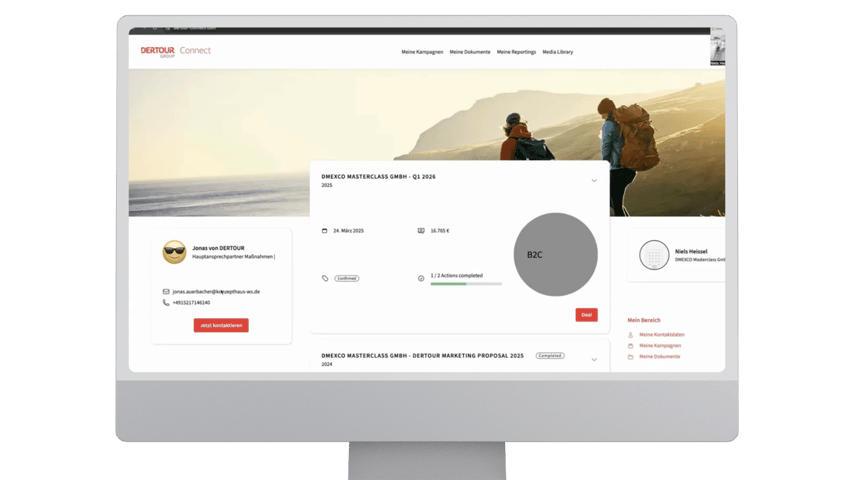
For any questions, there’s also an integrated chat feature that allows partners to communicate directly with the DERTOUR team.
The main advantage is that these features are not isolated from one another. Information on offers, planned activities, and required materials is all part of a single shared platform.
This facilitates collaboration on both sides. Partners can find relevant information in one central location, while internal teams can better track and coordinate activities. Personal support remains in place but is supplemented by digital services.
Such workflows are not limited to the travel industry. Manufacturers conducting joint sales campaigns with their dealers, or companies with a network of sales and cooperation partners, can also organize similar processes through a portal.
What were the results of the joint initiative?
After carrying out a marketing campaign, an important question arises for both sides: What results were achieved?
If reports have to be generated in different systems and then sent out individually, this creates additional coordination work. Furthermore, it is not always easy for partners to attribute the results to the respective activities.
DERTOUR Connect therefore features integrated reporting. Partners can track the results of their campaigns within the platform and access the corresponding reports.
This means the digital workflow doesn’t end with the planning or execution of a campaign. Performance monitoring is also part of the collaborative process.
This is particularly valuable for companies that regularly carry out marketing or sales activities with their partners. When offers, initiatives, and results are linked, it creates a better foundation for evaluating the collaboration and planning future activities.
The benefits of a partner portal are thus evident not only in individual tasks. They arise primarily from the fact that multiple interrelated steps can be organized via a shared platform.
What Companies Can Learn from the DERTOUR Example
Not every company needs a comprehensive catalog of initiatives or integrated campaign reporting. Nor does a partner portal have to map out all processes from the very beginning.
What matters most is which tasks regularly arise in collaboration with your own partners and how these are currently handled.
Start with a specific process
Anyone planning a partner portal should first take a closer look at a specific workflow. This could be, for example, a request for a quote: What information does a partner need? What details must they provide? Who processes the request, and what steps follow?
Once these questions are clarified, it becomes easier to assess which functions are needed and which steps can be automated.
A well-defined initial use case can already make a noticeable difference. Additional features can be added later, provided the technical foundation has been planned accordingly.
Effectively Combining Self-Service and Personal Support
A partner portal is designed to facilitate collaboration, not to replace personal contact.
Especially when it comes to customized offers, strategic decisions, or special requirements, dedicated contacts remain essential. Recurring tasks, such as retrieving information, providing documents, or submitting standardized requests, can often be handled by partners themselves.
This gives internal teams more flexibility to focus on tasks that actually require personal coordination.
Take internal processes into account from the start
A user-friendly portal interface alone is not enough if all the information behind it still has to be entered manually.
That’s why existing CRM data, responsibilities, and other enterprise systems should be incorporated into the planning process early on. It’s particularly important to determine what information is already available and how it can be leveraged for digital partner processes.
With its CRM, Content Hub, and automation features, HubSpot provides a foundation for such solutions. Specific partner processes, complex permission structures, or custom interfaces may require additional development.
This is exactly where we at konzepthaus come in. We integrate HubSpot with custom portal features and existing enterprise systems so that the solution is not only easy for partners to use but also supports the work of internal teams.
If you’d like to learn more about the technical and conceptual possibilities, you’ll find further information and project examples on our service page for customer, partner, and member portals.
Conclusion: Good partner management connects people and processes
Digital partner management can do far more than just centrally provide documents or offer a personal login area.
The DERTOUR example shows how collaboration can be structured across multiple steps: A partner learns about marketing initiatives, requests a quote, exchanges necessary documents, and can then track the results of their activities. The underlying information and processing workflows are interconnected via the platform.
For companies, this means fewer manual handoffs, greater transparency, and more efficient collaboration. Partners benefit from easy access to the information and services they need for their daily work.
What matters is not the number of partners or the scope of the portal. What matters is which processes can be meaningfully streamlined as a result.
Those who take a closer look at their own partner management often discover concrete opportunities to use a digital portal to reduce the workload for both internal teams and business partners.