Sales Automation in CRM
How Smart Deal Progression Optimizes the Sales Process from Initial Contact to Closed Deal
Every salesperson knows this moment. A conversation goes really well, the customer shows interest and the next steps are actually clear. In theory, everything is prepared so that a deal can be successfully continued.
In practice, however, something else often happens.
The context of the conversation is not properly transferred to the CRM, the follow-up is delayed or gets lost in day-to-day business. What initially looks like a promising opportunity loses momentum as a result.
Not because the conversation was bad, but because the transition between conversation and implementation does not work consistently.
The real bottleneck in the sales process
The problem rarely lies in the conversation itself. The real challenge begins afterwards.
Central tasks need to be completed after every customer meeting: Information must be documented, CRM data updated and next steps defined. At the same time, appropriate follow-up must be carried out based on the conversation.
In reality, however, it is precisely this step that often leads to frictional losses. Notes remain incomplete, CRM entries are maintained with a delay and follow-ups lose relevance.
The result is a discrepancy between the actual conversation and what is mapped in the system.
This gap has a concrete impact on sales: deals stagnate, pipeline data becomes inaccurate and opportunities are not consistently followed up.
Smart Deal Progression as a link between conversation and implementation
This is exactly where Smart Deal Progression comes in.
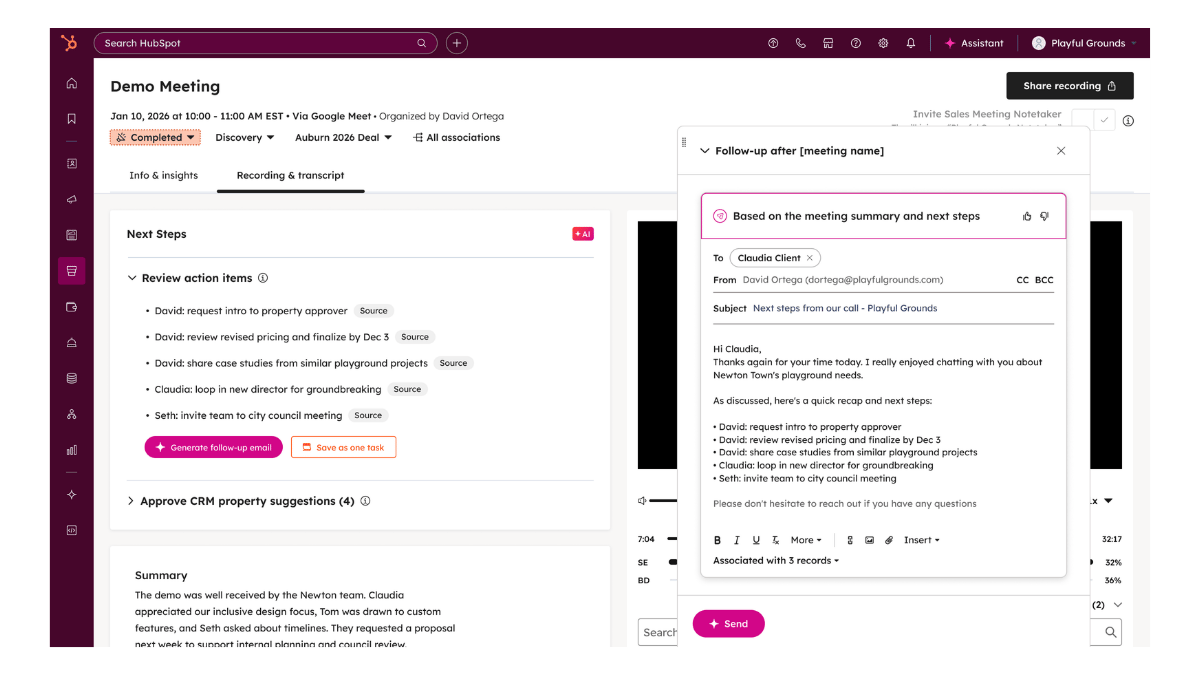
The approach is designed to close the gap between conversation and implementation. After a meeting, HubSpot analyzes the content of the conversation and combines it with the existing context of the deal.
This forms the basis for concrete suggestions that can be used directly in the sales process.
These include, among other things
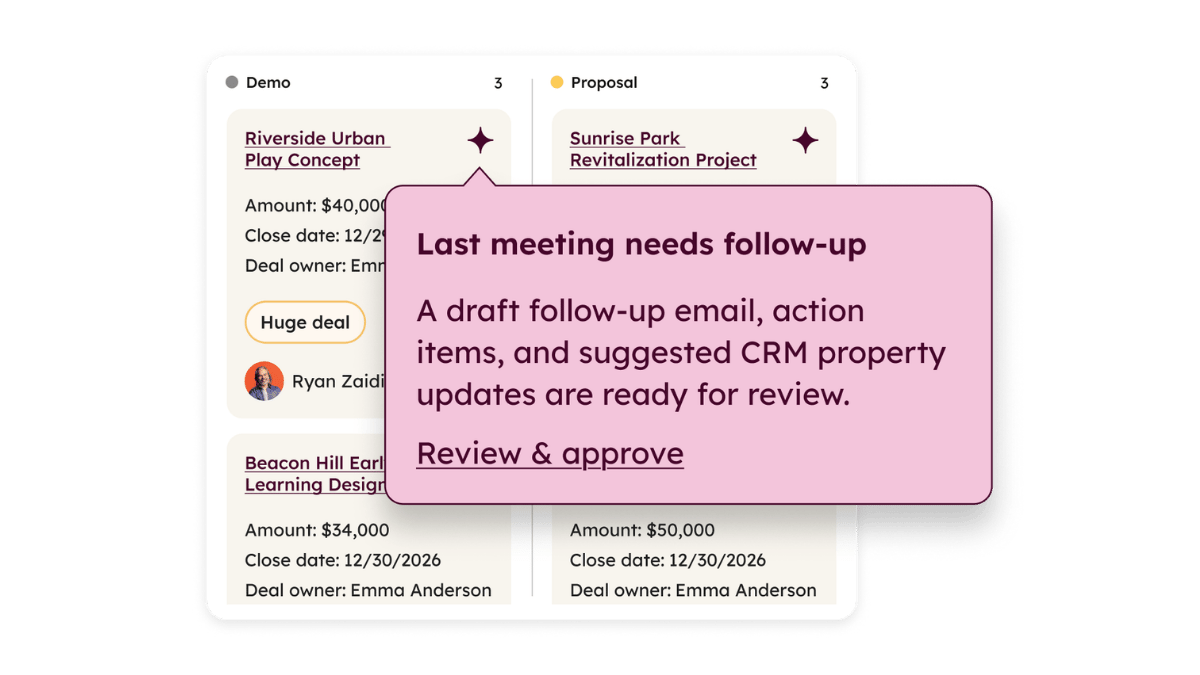
- suggested updates in the CRM, such as the deal stage or the next step
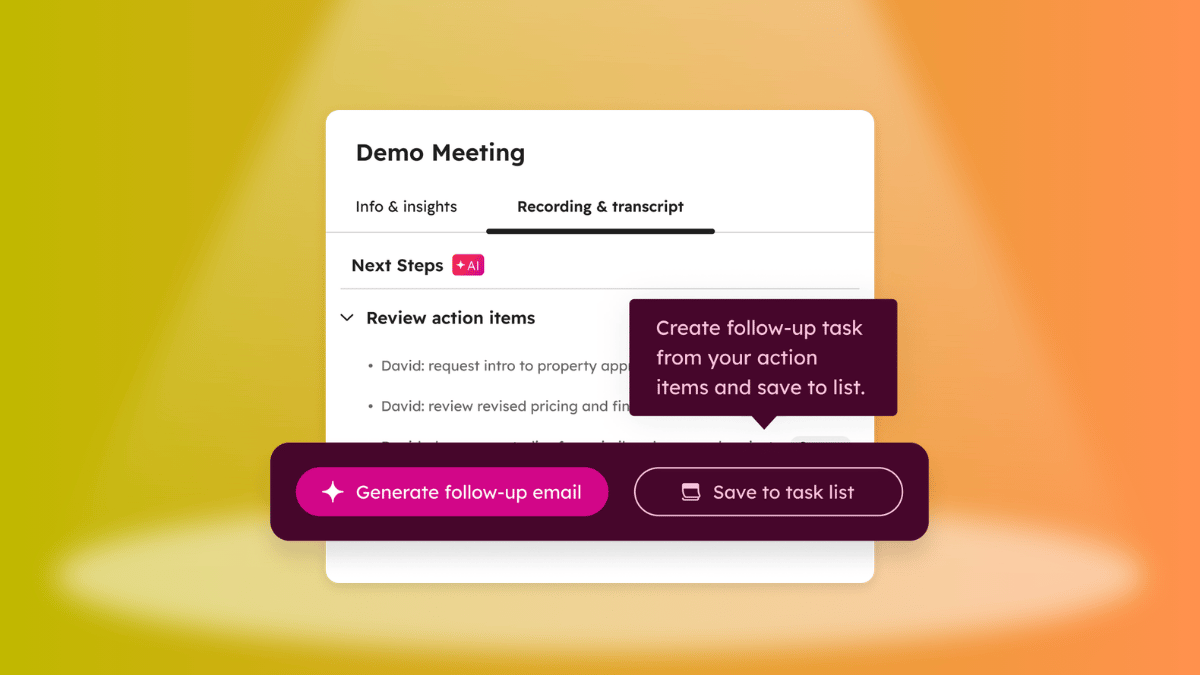
- an automatically generated draft for a follow-up email
- as well as specific recommendations for action that can be adopted as tasks
The key difference is that these suggestions are not generated in isolation, but are based on the full context of the customer and the deal.
More than just a meeting tool
Many solutions in the field of AI-supported meeting tools focus purely on summarizing conversations. They provide minutes, notes or transcripts that then have to be processed manually.
HubSpot's Smart Deal Progression goes one step further.
The call data is not only analyzed, but also directly linked to the existing CRM context. This includes previous interactions, emails, notes and the entire history of the respective deal.
The existing sales processes are also taken into account. This means that suggestions are not generic, but are based on the specific pipeline logic and internal processes.
This creates a system that not only provides information, but also actively supports the translation of this information into concrete measures.
Why this makes a difference in day-to-day sales
If it is clear after every conversation what the next step is, the entire dynamic in the sales process changes.
Instead of collecting information retrospectively or postponing decisions, a clearly structured process is created directly after the meeting.
This ensures that:
- Follow-ups are implemented faster and more consistently
- CRM data remains significantly more up-to-date and complete
- and deals are less likely to get stuck in the early stages
Above all, however, there is a better focus in day-to-day sales.
Sales teams spend less time on administrative tasks and more time in direct contact with customers.
What HubSpot does differently here
The key difference to other solutions lies in the way context is used.
While many tools only look at the current call, HubSpot connects the call data with the entire system.
This means that:
- conversation content is analyzed in the context of the complete deal history
- existing CRM data is actively incorporated into the suggestions
- and the recommendations are based on the company's actual processes
This connection ensures that the suggested next steps and follow-ups are not generic, but tailored to the specific situation.
The creation of follow-up emails also benefits from this. Instead of standardized texts, content is created that is based on the entire customer relationship and takes the context of the conversation into account.
Conclusion: Conversations become structured processes
Smart Deal Progression does not change the conversation itself, but what happens afterwards.
The focus is on making the transition between conversation and implementation as seamless as possible. This turns a single meeting into a clearly structured process that leads directly to concrete measures.
For sales teams, this means less friction on a day-to-day basis, faster response times and higher quality in the follow-up of deals.
And this is precisely where the real added value lies: good conversations no longer just remain good conversations, but consistently lead to better results.